
Grief can fuel war. Or stop it.
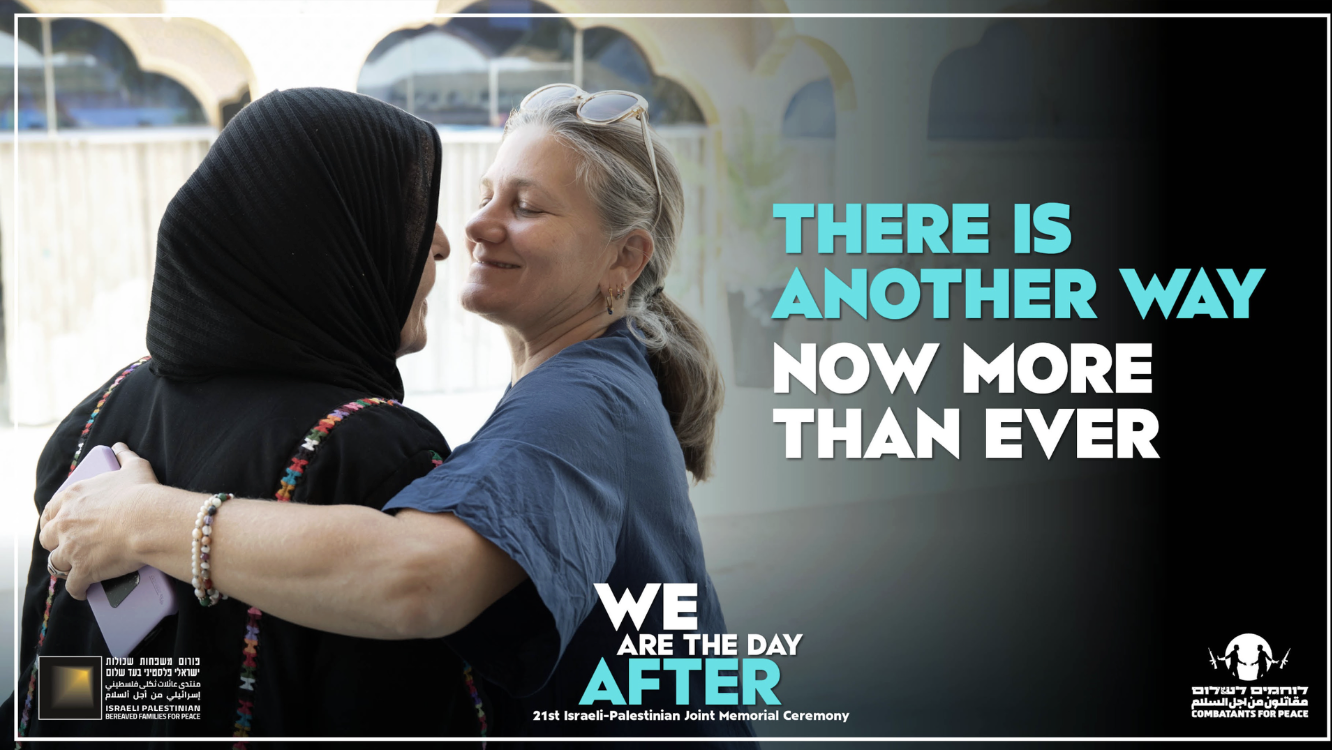
As violence escalates, those who have paid the highest price are forging a different path and calling us to join them. The Joint Memorial Day Ceremony, organized by Combatants for Peace and the Parents Circle Families Forum, is just a week away.
Below, two AFCFP board members share why this year’s ceremony matters:
Reflection from Michelle I. Gawerc, author and professor of sociology at Loyola University Maryland:
"Right now, the region is trapped in a widening web of violence, from Gaza and the West Bank and Lebanon to a fragile and contested truce between the U.S., Israel, and Iran. After a century of conflict, close to 60 years of military occupation, and nearly 20 years of siege, the same logic continues to dominate: that more violence will somehow bring security. At the same time, we are witnessing a dangerous erosion of moral clarity, where the humanity of entire populations is dismissed or denied.
The Joint Memorial Ceremony directly confronts this reality. It challenges the illusion of a military solution by amplifying the voices of those who know its price best. As former combatants and bereaved parents tell us, revenge only fuels more revenge. In doing so, they highlight what decades of social science research confirms: true long-term security is not achieved through military might, but through building the political, legal, and social conditions that ensure freedom, equality, and dignity for all. For me, this is a rare space of moral clarity—one that calls us to oppose attacks on civilians everywhere while confronting the entrenched injustice that makes repeated escalation inevitable.
In the face of such devastation, I’ve come to see joint mourning not as a passive act, but as a form of refusal—a refusal to let the dead be used as fuel for more war, and a choice to transform that grief into an assertion of our shared humanity. This ceremony is also an act of solidarity, one that acknowledges the tremendous asymmetry inherent in the occupation, with Israelis and Palestinians sharing not only the profound commonality of their grief but also, critically, the stark and unequal realities of their lived experiences. Ultimately, this makes the ceremony a direct rejection of the status quo, from its grotesque physical violence to the structural realities of occupation and siege, and the cultural beliefs that uphold both.
In this light, attending this screening is a way to reject the indifference that allows this violence to persist. And it is a recognition of the fundamental reality that our lives and fates are inextricably intertwined—a human reality for the nearly 15 million people living between the river and the sea who, almost evenly divided between Israeli Jews and Palestinians, have few, if any, other options.
I am encouraged by those who have every reason to turn toward bitterness—the bereaved families and former combatants—yet still choose a different path. They remind us that hope is an active practice. As Rami Elhanan of the Parents Circle often reminds us, for those who have paid the highest price, despair is a luxury they cannot afford. Joining this ceremony is an embodiment of that active hope—a choice to take a tangible step toward the world we deeply long for."
Reflection from Sulaiman “Souli” Khatib, CfP Palestinian Co-Founder, author, international peace activist, and lecturer:
“The Joint Memorial Ceremony is a glimpse of what we might call a third story, a new story. It is rooted not only in generational trauma, in history, and in the painful reality we are living right now, but also in a shared history and a shared humanity in this land and beyond it.
It brings back something that has been suppressed in all of us: the ability to imagine. To imagine a just world. A free world. A world where our freedom is not separate, but interconnected, where our safety, our dignity, and even our moral values are interconnected. For me, it reflects something essential: the humanization of all of us, on all sides.
We are not only victims of our reality, but we are responsible for changing it. Again and again, I come back to this: despite everything, despite the darkness of this reality, I have a choice, I feel freedom inside me, and no force in the world can take that away from me or any one of us. This is not about being disconnected from reality. It is about being deeply grounded in it and choosing something different.
I want to acknowledge our international community, those who stand with us in solidarity. Our togetherness matters. It is not symbolic. It is working and changing the discourse. It is breaking the idea that this is only a story of ‘us and them.’ It is a courageous, historical act to say: there is another narrative that includes everyone. A narrative that leaves no one outside. The Joint Palestinian-Israeli Memorial Ceremony is sacred work. There are so many people behind it who have lost loved ones in this ongoing violence and under occupation, and still, they come together. They come with their full truth: their grief, their anger, their identity, their belonging. Nothing is left outside. And at the same time, they hold a space of empathy for what we call ‘the other.’ And slowly, the ‘other’ becomes a brother. A sister.
This is the way forward. And this is not something for the future. It is happening now. In many places, this kind of work happens only after violence ends. What we are doing is different. We are forging justice and reconciliation in real time, creating an alternative now, and planting seeds for a future that we may not fully see, but that future generations will inherit. Like the olive trees, we say: others planted, and we ate; we plant, and the next generation will eat. The ceremony is generational work, community work. It is how healing and collective liberation take place, by facing generational trauma on all sides. It is a real alternative. Not an idea or an experience. Something lived together.
I am deeply proud to be part of this. And I invite people everywhere to join. Come grieve with us. Come witness. Come see the possibility, and renew your commitment to this work. Because there is enough for everyone. Enough dignity, enough safety, enough life to share. And our global community reminds us we are not alone."